Sardegna
identità
Culture, language and symbols of a Mediterranean island with a singular identity.
Sardinia is not, in the ordinary sense, a « region » of Italy. It is an island-continent, with its own language, sardo, recognised as a language in its own right -, its cultural archaisms, its millennia-old pastoral traditions and a history marked by Phoenician, Punic, Roman, Byzantine, Pisan, Aragonese, Spanish, Piedmontese, then Italian influences.
Four Moors
on a St George cross
The Sardinian flag, of medieval origin, probably introduced by the Crown of Aragon in the 14th century, shows four Moor heads arranged around a red cross on a white field. According to the dominant tradition, it commemorates the Christian victories over the Saracens during the Iberian Reconquista, but its exact interpretation remains debated.
This flag has known two great historical versions which are distinguished by an apparently tiny detail, the position of the Moors' headband, but with considerable symbolic significance. It is not just a graphic choice: it is a political statement.
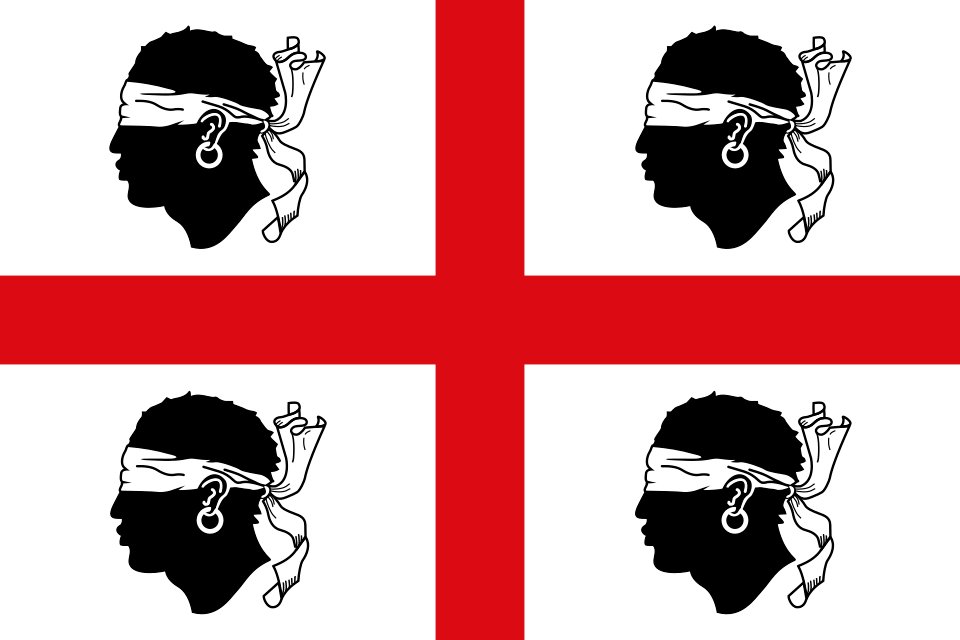
Domination, subjection. This representation, spread from the 19th century for reasons that remain unclear, evokes the figure of the vanquished with veiled eyes.
1999
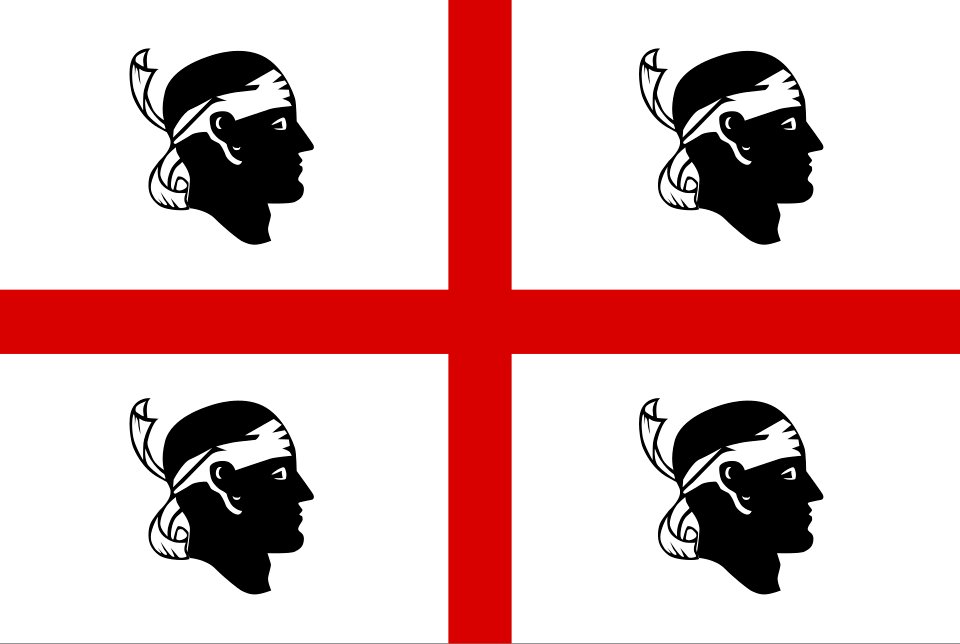
Freedom, dignity, recovered identity. Adopted by the Autonomous Region in 1999 with visible eyes and the orientation of the heads modified, a gaze turned towards the future.
The shift from the headband over the eyes to the headband on the forehead is often read as the passage from a symbol of submission to a symbol of freedom and asserted Sardinian identity.
One island, several languages
Spoken in the Campidano, Cagliari, Sarrabus.
Variety considered more conservative, in the heart of Barbagia.
Variety close to southern Corsican, spoken in Gallura.
Tuscan-influenced variety, legacy of medieval ties with Pisa.
Some historical
anchors
Nuragic civilisation
Megalithic towers (nuraghes) built by the indigenous civilisation, over 7,000 nuraghes recorded on the island.
Phoenicians and Carthaginians
Coastal trading posts, founding of Nora, Tharros, Sulki.
Roman conquest
Sardinia becomes a Roman province. The interior is never fully Romanised (hence the survival of Sardinian).
The four giudicati
Arborea, Cagliari, Torres, Gallura, autonomous indigenous kingdoms before the Aragonese arrival.
Piedmontese Kingdom of Sardinia
The House of Savoy receives the island; prelude to Italian unification.
Autonomous region
Sardinia becomes a special-statute region of the Italian Republic.
« Barbagia has never been entirely conquered. »
Chapter IV, Sardinian banditry →